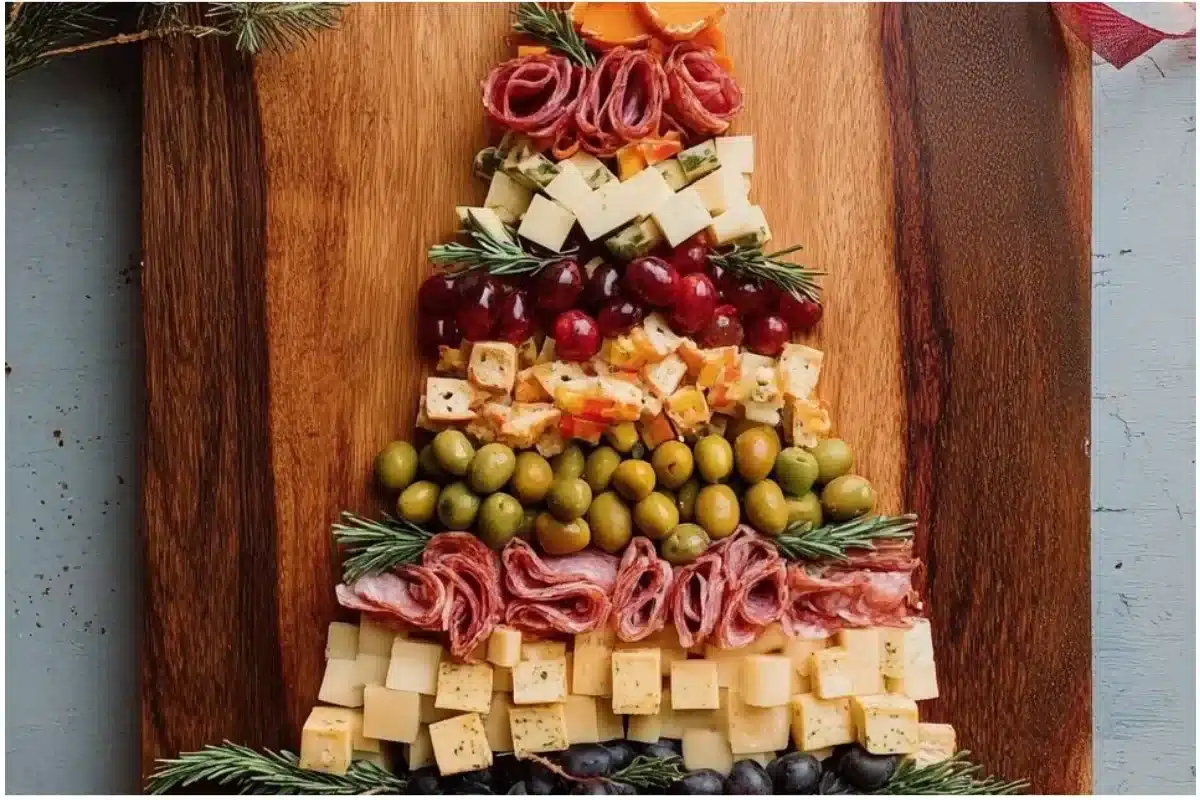
Turn a crowd-pleasing charcuterie into a showstopper: a Christmas Tree Shaped Charcuterie Board is festive, sharable, and surprisingly simple when you use a plan. This article walks you from ingredient science to step-by-step assembly, with pro tips, variations, storage instructions, nutrition insights, and a complete recipe card so your holiday spread looks professional without the stress.
Whether you’re hosting a big family party or bringing an eye-catching appetizer to a potluck, this guide explains not only what to put on the board but why it works — flavor balance, texture contrast, and visual rhythm — so your tree will be as delicious as it is beautiful. If you love visual grazing platters, you’ll also appreciate similar layout logic used in a checkerboard salad recipe — the same principles of contrast and repetition make any platter sing.
Why a Christmas Tree Shaped Charcuterie Board works
A shaped board — triangular like a Christmas tree — uses geometric cues to organize food in a way viewers instantly recognize. The human eye finds symmetry and pattern pleasing; the triangular canvas creates natural zones (base, middle, tip) for varied textures and flavors. This makes it easier for guests to navigate the board and for you to pace flavor placement (bold items near the base, delicate ones toward the top).
From a culinary standpoint, a successful charcuterie board balances:
- Fat (cheeses, pâté) for mouthfeel and satiety
- Salt (cured meats, olives) to amplify taste
- Acid (pickles, grapes, chutney) to cut richness
- Crunch (crackers, nuts, crisp vegetables) for texture contrast
- Sweet (dried fruit, honey) to create lift and contrast
This structure is especially useful during busy holidays when guests graze between activities — the board needs to remain attractive and functional for hours.
Print
Christmas Tree Shaped Charcuterie Board
- Total Time: 60 minutes
- Yield: 8–12 servings 1x
- Diet: Vegetarian
Description
A festive and visually appealing charcuterie board shaped like a Christmas tree, perfect for holiday gatherings.
Ingredients
- 8 oz Brie or Camembert (cut into wedges)
- 8 oz aged Cheddar (sliced or cubed)
- 10 oz Manchego (thin slices)
- 6–8 oz goat cheese log (optional rolled in herbs)
- 6 oz prosciutto (paper-thin slices)
- 8 oz Genoa salami (sliced)
- 6 oz chorizo or peppered salami (sliced)
- 2 cups red grapes
- 1 cup pomegranate arils or mixed berries
- 1–2 pears or apples, thinly sliced and tossed with lemon
- 1 cup assorted olives and cornichons (in a bowl)
- 1 cup mixed nuts (toasted)
- 1 baguette (sliced and toasted) and a selection of crackers
- 1/2 cup fig jam or apricot preserves
- 3 tablespoons honey or honeycomb piece
- Fresh rosemary and thyme sprigs
- Small edible star (cheese cutout or cookie cutter star)
Instructions
- Prep cheeses and meats: slice semi-hard cheeses, wedge soft cheese, and portion goat cheese. Fold prosciutto into loose ribbons; roll salami into cones.
- Arrange bowls: place two or three small bowls near the base for olives and spreads.
- Establish border: create the triangular outline by placing crackers or bread slices in a layered, overlapping pattern to define the tree’s edges.
- Build the base: at the widest part, place larger items — bowl of olives, cluster of grapes, and a wedge of Brie.
- Create horizontal garlands: across the triangle, alternate rows of meat, cheese, and produce for visual rhythm.
- Add texture pockets: tuck clusters of nuts and dried fruit into small gaps.
- Top detail: at the tip, place the edible star and a few sprigs of rosemary.
- Final touches: drizzle honey over cheese or place a honeycomb piece in a bowl, and scatter rosemary and cranberries for color.
Notes
Keep bowls filled and replace items as they run low. For long events, replace sliced fruit later to keep it fresh.
- Prep Time: 45 minutes
- Cook Time: 0 minutes
- Category: Appetizer
- Method: No Cooking
- Cuisine: American
Nutrition
- Serving Size: 1/12 board
- Calories: 450
- Sugar: 10g
- Sodium: 600mg
- Fat: 30g
- Saturated Fat: 15g
- Unsaturated Fat: 10g
- Trans Fat: 0g
- Carbohydrates: 40g
- Fiber: 5g
- Protein: 18g
- Cholesterol: 50mg
Keywords: charcuterie board, Christmas appetizer, holiday food, festive platter, cheese and meat platter
Planning your board: size, tools, and layout
Choose a board size based on guest count: plan about 3–4 ounces of charcuterie and 2–3 ounces of cheese per person if the board is the main appetizer. For large parties where the board is one of several appetizers, scale down to 2 oz charcuterie and 1 oz cheese per person.
Tools and supplies
- Large rectangular or triangular wooden board (or make a triangle with parchment on a rectangular board)
- Sharp chef’s knife and a cheese knife/plane
- Small bowls for spreads and olives
- Offset spatula or small palette knife for spreading
- Tweezers or toothpicks for precise placement (optional)
- Parchment or wax paper for staging
Layout blueprint
- Use the triangle’s edges to anchor crackers and long items (breadsticks, grissini).
- Create horizontal “garlands” across the triangle with alternating cheeses and meats.
- Place bowls (olives, mustard, jam) in the wider base area for stability.
- Finish with a star at the tip (small round of cheese, pastry star, or a cluster of figs).
Ingredient breakdown with cooking logic and benefits
Below is a working list with reasoning for each category and the culinary science behind their role on the board.
Cheeses (fat/protein, texture contrast)
- Soft: Brie, Camembert, Boursin — spreadable, rich, mild. Soft cheeses temper salty meats and pair well with fruit preserves.
- Semi-soft: Havarti, Gouda, Monterey Jack — sliceable and kid-friendly.
- Semi-hard/hard: Manchego, aged Cheddar, Gruyère — provide firm bite and nutty, umami-rich flavors.
- Fresh: Goat cheese, ricotta-stuffed pearls — bright and tangy, good next to sweet fruit.
Why variety matters: different moisture and fat levels change mouthfeel and how they pair with other items. Aged cheeses have more umami and crystalline texture from tyrosine; fresh cheeses bring lactic brightness.
Cured meats (salt, savory, aroma)
- Prosciutto — delicate, melts on the tongue due to fat content.
- Salami (soppressata, Genoa) — chewy, holds shape when folded into cones.
- Chorizo or peppered salami — adds spice and color contrast.
- Coppa or bresaola — leaner, with a firmer bite.
Science note: fat and salt in cured meats activate salivary enzymes and enhance flavor perception. Fold meats to increase perceived volume without overwhelming the board.
Produce (acid, sweetness, texture)
- Grapes, pomegranate arils, figs, apple or pear slices — sugar and acidity to cut fat.
- Cornichons, olives, pickled onions — vinegary bite that resets the palate.
- Fresh herbs like rosemary and thyme — aromatic lift and visual green.
Nuts and crackers (crunch, fat)
- Marcona almonds, candied pecans, walnuts — crunchy contrast; toasted nuts add warm, caramelized notes.
- Variety of crackers and crisps — choose neutral water crackers, seeded crackers, and toasted baguette slices.
Spreads and sweeteners
- Fig jam, apricot preserves, honeycomb, grainy mustard — combos that pair with both cheese and meat.
- Hummus or herbed labneh for vegetarian guests.
Color/decoration
- Edible flowers, rosemary sprigs, and cranberries add seasonal red and green accents.
Benefits: combining these categories maximizes guest satisfaction. The acids keep palate fatigue at bay; sweet-salty contrasts are intrinsically rewarding.
Shopping list and quantities (for 8–12 people)
- Cheeses: 3–4 types, total ~2.5–3 lbs (e.g., 8 oz Brie, 8 oz aged Cheddar, 10 oz Manchego, 8 oz goat cheese)
- Cured meats: 3–4 types, total ~1.5–2 lbs (e.g., 6 oz prosciutto, 8 oz Genoa salami, 6 oz chorizo, 6 oz coppa)
- Fresh fruit: 2 cups grapes, 2 pears/apples, 12 figs or 1 cup pomegranate arils
- Pickles/olives: 2 cups mixed
- Nuts: 1–2 cups assorted
- Crackers/bread: 4–5 sleeves or 2 baguettes sliced
- Spreads: 3 small bowls (honey, jam, mustard)
- Garnish: rosemary, thyme, cranberries
You can scale up or down — keep balance in mind: roughly 60% savory (meat & cheese) to 40% complementaries (fruit, nuts, crackers).
Christmas Tree Shaped Charcuterie Board — Recipe Card
Recipe: Christmas Tree Shaped Charcuterie Board
Servings: Serves 8–12 as an appetizer
Prep time: 45 minutes (plus up to 2 hours of chilling time for arranged items)
Total time: 45–60 minutes
Ingredients
- 8 oz Brie or Camembert (cut into wedges)
- 8 oz aged Cheddar (sliced or cubed)
- 10 oz Manchego (thin slices)
- 6–8 oz goat cheese log (optional rolled in herbs)
- 6 oz prosciutto (paper-thin slices)
- 8 oz Genoa salami (sliced)
- 6 oz chorizo or peppered salami (sliced)
- 2 cups red grapes
- 1 cup pomegranate arils or mixed berries
- 1–2 pears or apples, thinly sliced and tossed with lemon to prevent browning
- 1 cup assorted olives and cornichons (in a bowl)
- 1 cup mixed nuts (toasted)
- 1 baguette (sliced and toasted) and a selection of crackers
- 1/2 cup fig jam or apricot preserves
- 3 tablespoons honey or honeycomb piece
- Fresh rosemary and thyme sprigs
- Small edible star (cheese cutout or cookie cutter star)
Equipment
- Large board or large parchment on a flat surface, small bowls, cheese knives, offset spatula
Directions
- Prep cheeses and meats: slice semi-hard cheeses, wedge soft cheese, and portion goat cheese. Fold prosciutto into loose ribbons; roll salami into cones.
- Arrange bowls: place two or three small bowls near the base for olives and spreads.
- Establish border: create the triangular outline by placing crackers or bread slices in a layered, overlapping pattern to define the tree’s edges.
- Build the base: at the widest part, place larger items — bowl of olives, cluster of grapes, and a wedge of Brie.
- Create horizontal garlands: across the triangle, alternate rows of meat, cheese, and produce. Use repetition (e.g., salami, cheese slices, grapes) to create visual rhythm.
- Add texture pockets: tuck clusters of nuts and dried fruit into small gaps.
- Top detail: at the tip, place the edible star and a few sprigs of rosemary to mimic needles.
- Final touches: drizzle honey over a small wedge of blue cheese or place a honeycomb piece in a bowl. Scatter rosemary sprigs and fresh cranberries for color.
- Serve with small spoons and cheese labels if desired.
Notes: Keep bowls filled and replace items as they run low. For long events, replace sliced fruit later to keep it fresh.
Step-by-step assembly with real cooking insights
Step 1 — Prep like a pro
- Slice cheeses fully and leave soft cheeses whole until assembly to avoid drying. Pre-slice harder cheeses and tuck the slices in fanned stacks. This reduces assembly time and keeps the board tidy.
- If using apples or pears, toss slices with a little lemon juice to delay browning.
Step 2 — Create structure first
- Position bowls and the base elements first. A bowl anchored near the base keeps the center stable and gives you a visual anchor for layering the rest.
Step 3 — Build rows, not random piles
- Instead of scattering everything, build horizontal “garlands” from the base up. This creates a clear tree shape and improves guest navigation. Alternate elements to maintain balance: cheese–meat–fruit–crunch.
Step 4 — Use height intentionally
- Fold meats into cones or ribbon them to create height and shadow. Stack a small wedge of firm cheese on a cracker to form mini trees within the tree.
Step 5 — Mind the temperature
- Cheese tastes best at room temperature. Take soft and semi-soft cheeses out 30–45 minutes before serving; keep others cooler until 15–20 minutes prior. Cold cheese tastes blander; warmed cheese reveals more aroma and fat.
Step 6 — Finish with aromatics and a star
- Herbs like rosemary not only add color but release piney aromas that evoke holiday scent profiles. A star-shaped cheese cutout, pastry, or cookie at the tip completes the design.
Tips, pro advice, and mistakes to avoid
Pro tips
- Use at least three cheese textures to keep variety.
- Place high-salt items (olives, prosciutto) spaced out to avoid one overly salty quadrant.
- Fill gaps with small clusters of nuts or fruit to maintain the shape without crowding.
- For portability, assemble on a tray you can slide onto the display board; this helps if you’re transporting the platter.
Mistakes to avoid
- Don’t over-pack the board. A crowded board looks messy and makes it hard to access items.
- Avoid warming delicate cheeses too long; they can become runny and lose their shape.
- Don’t forget utensils. Small spreaders and tongs help guests serve without damaging the layout.
Shortcuts for busy hosts
- Buy pre-sliced salami and pre-toasted baguette slices.
- Use store-bought honeycomb or marinated olives to save prep time.
- Assemble a “skeleton” of the board ahead of time (bowls, crackers, large cheeses) and add delicate items 30 minutes before guests arrive.
Variations and swaps
Vegetarian tree
- Replace cured meats with grilled marinated vegetables (zucchini ribbons, roasted peppers), falafel bites, and herbed labneh. Add more legumes-based spreads like muhammara or hummus.
Keto/low-carb tree
- Skip crackers and bread. Increase nuts, cheeses, and meats. Use cucumber slices and pepperoncini as low-carb crunchy alternatives.
Family-friendly / kid-friendly tree
- Use mild cheeses (Colby, mozzarella), sliced apple rings, grapes, mini pretzels, and turkey pepperoni. Make a cookie star for the tip to delight kids.
International flair
- Mediterranean: add marinated feta, dolmas, roasted red peppers, olives, and lavash.
- Spanish: include manchego, chorizo, membrillo (quince paste), and marcona almonds.
Ingredient swaps
- Goat cheese for Boursin to increase tang.
- Fig jam for apricot preserves for a fruitier note.
- Candied walnuts instead of plain toasted for a sweet crunch.
Serving suggestions and pairings
Drink pairings
- Sparkling wine or Champagne — cuts through fat and refreshes the palate.
- Light red like Pinot Noir for aged cheeses and salami.
- Beers: Saison or Belgian ale pairs well with a variety of cheeses.
- Non-alcoholic options: sparkling apple cider or a festive mocktail.
Complementary dishes
- If you’re planning dessert or later platters, consider balancing richness with lighter options like a fresh salad (see this seasonal salad idea in the checkerboard salad recipe). For dessert follow-ups, festive bites like Christmas bars and classic Christmas cookies make a perfect finish — place them away from the grazing station to keep flavors distinct.
Serving order
- Put spreads and bowls toward the base so guests can grab spreads immediately. Replenish crackers and fresh fruit frequently to keep the board full and attractive.
Storage, leftovers, and reheating
Short-term storage
- Cover the board loosely with plastic wrap or transfer leftover items to airtight containers. Keep cheeses wrapped in wax paper or cheese paper if possible; plastic wrap can trap moisture and alter texture.
Refrigeration
- Most components store well for 2–4 days refrigerated. Fresh fruit and delicate herbs will decline fastest; remove them if you plan to keep leftovers.
Reusing leftovers
- Transform leftovers into a warm dish: slice remaining cheeses and melt into a skillet with roasted vegetables and cured meat for a quick gratin-style skillet; top with breadcrumbs and broil.
- Use meats and cheeses in sandwiches or pasta carbonara-like dishes (dice cured meat and add to pasta with cream and grated hard cheese).
Avoid reheating tips
- Do not microwave cheeses — they can separate. Instead, use the oven or broiler for brief melting, or low-heat skillet.
Food safety
- Keep perishable items out of the temperature danger zone (40–140°F / 4–60°C) for more than 2 hours. Replace perishable items if they have been sitting at room temperature for too long during parties.
Nutrition insights
Calories and macros
- Charcuterie boards are concentrated in fat and protein, with carbohydrates primarily from crackers and fruit. For a balanced grazing plan, pair the board with fiber-rich sides (vegetable crudité, a leafy salad) to slow digestion and improve satiety.
Health considerations
- Sodium: cured meats and some cheeses are high in sodium; try lower-sodium options (cooked chicken, lean turkey slices) for guests with sodium restrictions.
- Saturated fat: choose a mix of full-fat and lower-fat cheeses to manage saturated fat intake.
- Allergens: label nuts, gluten-containing crackers, and dairy items to help guests with allergies.
Smarter swaps
- Swap candied nuts for dry-roasted nuts to reduce added sugar.
- Offer whole-grain crackers as a higher-fiber carb option.
- Include a bowl of crudités (carrots, cucumbers, bell peppers) to increase vegetable servings.
FAQ (schema-ready style)
Q: How far in advance can I assemble a Christmas tree charcuterie board?
A: You can prepare the “skeleton” — bowls, crackers, large cheeses, and base items — 2–3 hours ahead. Add delicate items (fresh herbs, soft cheeses, sliced fruit) 30–45 minutes before serving.
Q: What cheeses should I choose for a crowd-pleasing board?
A: Aim for three to four cheeses across textures: one soft (Brie), one semi-soft (Havarti), one hard (Aged Cheddar or Manchego), and one fresh/bright (goat cheese). This covers a broad range of flavors and textures.
Q: How do I keep apple and pear slices from browning?
A: Toss sliced fruit briefly in lemon juice or a diluted ascorbic acid solution (1 teaspoon lemon juice per cup of water) immediately after cutting. Keep refrigerated until assembly.
Q: Can I make a vegetarian version that still looks abundant?
A: Yes. Use grilled vegetables, marinated mushrooms, stuffed mini peppers, multiple cheese types, roasted chickpeas, hummus, fruit, nuts, and a wider assortment of crackers to create volume and variety.
Q: How can I transport a charcuterie tree to a party?
A: Assemble on a large tray or sturdy cutting board, cover loosely with plastic wrap, and transport in a cooler bag to maintain cool temperature. Add delicate items on-site if possible.
Q: What’s the best way to label cheeses?
A: Small tent cards or toothpick flags work well. For an elegant approach, write cheese names on a slate board with chalk.
Final presentation ideas
- Use fairy lights (battery-operated) around the board for evening events for a magical touch. Keep them off where food touches.
- Provide small tasting spoons for jams and honey to prevent double-dipping.
- Consider a “build your own crostini” station beside the board with toasted bread and small bowls of toppings for guests who prefer assembled bites.
Conclusion
A Christmas Tree Shaped Charcuterie Board is a strategic mix of flavor science and visual design — it organizes tastes, textures, and colors into an instantly recognizable holiday centerpiece. Follow the blueprint in this guide and you’ll create a board that’s easy to graze, easy to replenish, and memorable for guests.
For inspiration on decorative tree layouts and step-by-step visual guides, check out this practical version from Christmas Tree Shaped Charcuterie – Good Dinner Mom. If you want alternative assembly styles and creative topping ideas, see Christmas Tree Charcuterie Board | Ain’t Too Proud To Meg for more creative variations.
Enjoy building your edible tree — take pictures and share them with friends. If you want dessert ideas to pair after the board, try our recipes for sweet holiday treats like Christmas bars and classic Christmas cookies to round out your menu.