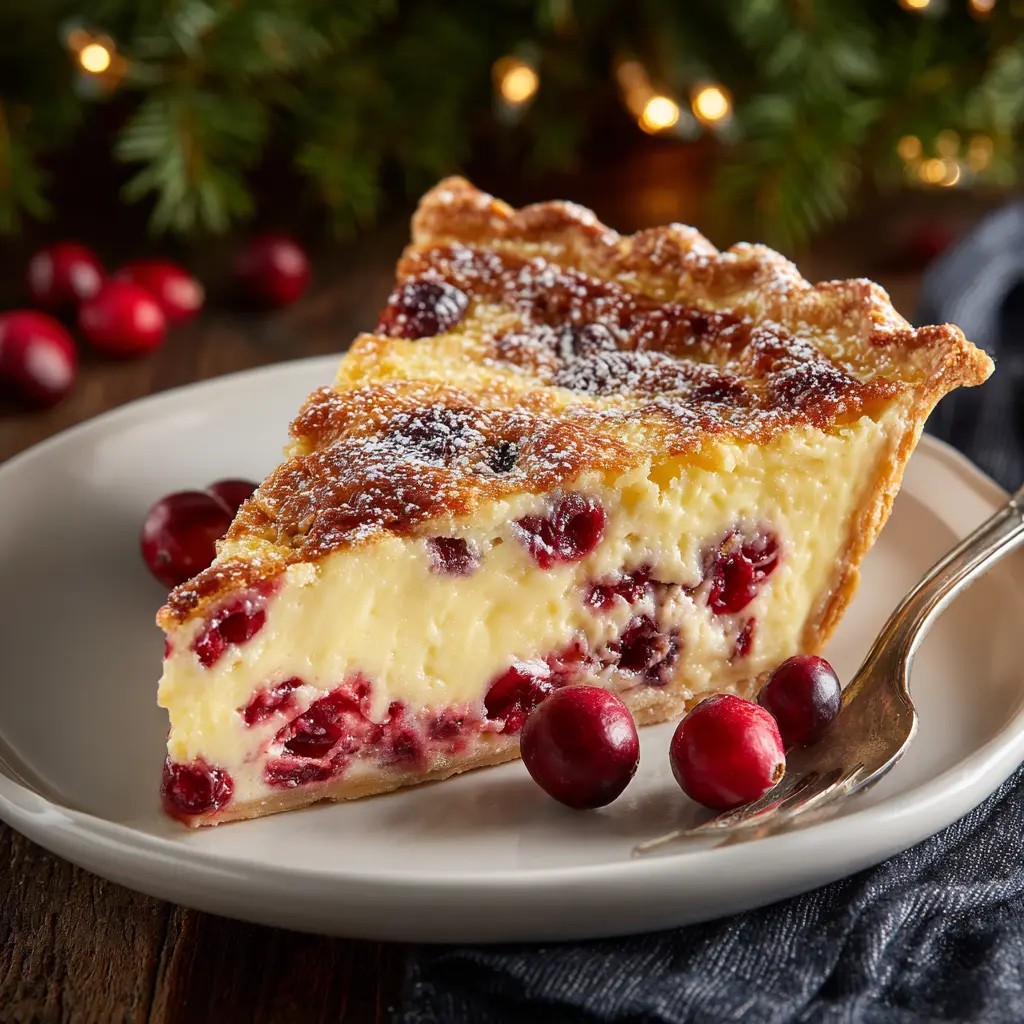
Cranberry Custard Pie is the kind of dessert that balances two often-opposed qualities: bright, wintery tartness and comforting, silky richness. If you want a showstopping holiday centerpiece or a streamlined, make-ahead dessert that still reads “fancy,” this pie does both. This guide gives you the full recipe, the reasoning behind each ingredient and technique, pro tips to avoid common pitfalls, storage and reheating instructions, variations for dietary needs, and thoughtful serving ideas.
If you want to compare different takes or find a quick cranberry appetizer to pair with this pie, try the baked cranberry brie bites for a savory contrast: Baked Cranberry Brie Bites.
Why this article matters: many online recipes give ingredient lists and steps but skip the why. Here you’ll get the why — the science behind custard texture, how cranberries affect set and flavor, and chef-tested techniques for a crack-free surface and even bake. Read on and you’ll walk away confident to make a Cranberry Custard Pie that slices clean, tastes balanced, and keeps well.
What is Cranberry Custard Pie?
Cranberry Custard Pie is a hybrid between a fruit pie and a classic custard pie. A single pie features:
- A blind-baked or partially baked tender pie crust (shortcrust or all-butter).
- A creamy egg-sugar-dairy custard that sets into a silky, sliceable filling.
- Fresh (or cooked) cranberries folded into the custard or scattered across the top before baking, giving bursts of acidity and texture.
The result is not jammy like cranberry pie with heavy sugar; instead, the berries remain pronounced and bright, complementing the mild, sweet custard.
Why choose cranberry custard over other pies? It’s less sweet than many fruit pies, which makes it an excellent partner for richer meals. It also freezes and reheats well and can be made a day ahead with minimal quality loss.
The recipe at a glance
(Yield: 8–10 servings)
- Prep time: 30–40 minutes (plus chilling the crust if making from scratch)
- Bake time: 35–50 minutes (depending on oven and whether crust was blind-baked)
- Total time: 1 hour 30 minutes (including cooling)
- Difficulty: Intermediate
Full recipe card is below for printing or saving.
Print
Cranberry Custard Pie
- Total Time: 90 minutes
- Yield: 8 servings 1x
- Diet: Vegetarian
Description
A refined dessert that combines bright, wintery tartness with comforting, silky custard, perfect for holiday gatherings.
Ingredients
- 1 (9-inch) pie crust, homemade or store-bought
- 3 large eggs, room temperature
- 1 cup granulated sugar
- 1/2 tsp salt
- 1 1/2 cups heavy cream (or 1 cup heavy cream + 1/2 cup whole milk)
- 1 tsp vanilla extract
- Zest of 1 orange (or 1 tsp lemon zest)
- 2 cups fresh cranberries
- 1–2 tsp cornstarch (optional)
- 1 tbsp unsalted butter, diced (optional)
- Powdered sugar for dusting (optional)
Instructions
- Preheat oven to 375°F (190°C). For blind baking, preheat to 400°F (204°C).
- Roll chilled pie dough to a 12-inch circle, fit it into a 9-inch pie dish, and chill for 15–30 minutes. If blind-baking, line with parchment and fill with weights, baking for 15 minutes, then remove weights and bake for 5–8 more minutes until lightly golden.
- Rinse and pick through cranberries. Option A: Use raw berries. Option B: Cook berries briefly with sugar and water until they start to pop, then cool.
- In a large bowl, whisk eggs with sugar and salt until combined. Add cream, vanilla, and zest. If using cornstarch, dissolve in a tablespoon of cream first.
- Scatter cranberries in the crust and pour the custard mixture over them. Dot with butter if desired.
- Bake for 35–50 minutes at 375°F until the custard is mostly set. Cool on a rack for 2 hours, then chill for at least 4 hours before serving.
- Dust with powdered sugar before serving, if desired.
Notes
For best texture, blind-bake the crust. If using fresh cranberries, consider tossing with cornstarch to absorb juices.
- Prep Time: 40 minutes
- Cook Time: 50 minutes
- Category: Dessert
- Method: Baking
- Cuisine: American
Nutrition
- Serving Size: 1 slice
- Calories: 400
- Sugar: 25g
- Sodium: 200mg
- Fat: 24g
- Saturated Fat: 15g
- Unsaturated Fat: 6g
- Trans Fat: 0g
- Carbohydrates: 45g
- Fiber: 2g
- Protein: 6g
- Cholesterol: 150mg
Keywords: cranberry, custard, pie, holiday dessert, winter dessert
Ingredient breakdown — what each component does (and why it matters)
Understanding the role of ingredients helps you adapt this pie without compromising texture.
- Pie crust (all-butter or vegetable shortening-based): The crust provides structure, buttery flavor, and a textural contrast to the silky custard. An all-butter crust is tastier but requires careful handling to avoid shrinkage; shortening yields a slightly flakier, more forgiving shell.
- Science tip: Cold fat creates layers in dough; overworking increases gluten and makes it tough.
- Granulated sugar: Sweetens the custard and helps with browning and texture. Sugar reduces the freezing point of liquids, stabilizes eggs, and dissolves into the custard matrix for a glossy finish.
- Eggs (whole): The primary custard-setting agent. Eggs coagulate between roughly 140–170°F (60–77°C) and create the custard’s structure. Whole eggs deliver balance between yolk richness and white protein for the right set.
- Heavy cream or half-and-half: Fat from cream contributes to silkiness and mouthfeel. For a lighter custard, use whole milk or a 50/50 mix of milk and cream — note the final texture will be less rich and more delicate.
- Vanilla extract and citrus zest: Vanilla adds warmth; citrus (orange or lemon zest) sharpens the berries. Zest brightens the custard without extra liquid.
- Salt: Salt enhances sweetness and rounds the flavor.
- Fresh cranberries: Provide tartness and texture. Cranberries also release pectin when cooked, which can slightly thicken the mixture around them. If you prefer softer berries, briefly simmer them with sugar before folding into the custard.
- Cornstarch or flour (optional): Some recipes add a small amount of cornstarch (1–2 teaspoons) to stabilize the custard and prevent weeping. Use sparingly — too much will make the custard gummy.
- Spices (optional): Cinnamon, nutmeg, or cardamom can add warmth that pairs well with cranberries.
Ingredient substitutions and effects:
- Dairy-free: Use canned full-fat coconut milk for richness; custard will be more fragile and slightly coconut-flavored.
- Lower sugar: Reduce sugar by 15–25% if using tart cranberries, but note the custard will set differently and may be less glossy.
- Pre-sweetened cranberry sauce: Avoid using heavy sauce unless you adjust sugar; sauce adds extra moisture and may make the custard wetter.
Tools and equipment
- 9-inch (23cm) pie dish (glass, ceramic, or metal)
- Rolling pin and pastry cloth or cold surface
- Mixing bowls, whisk, and rubber spatula
- Fine-mesh sieve (optional, for straining)
- Oven thermometer (recommended)
- Baking weights or dried beans (if blind baking)
- Baking sheet (to catch drips)
- Thermometer (instant-read) for precise custard set
Full Cranberry Custard Pie recipe card
Title: Cranberry Custard Pie Servings: 8–10 Prep Time: 30–40 min (plus chilling) Cook Time: 35–50 min Total Time: 1 hr 30 min
Ingredients:
- 1 (9-inch) pie crust, homemade or store-bought (see notes)
- 3 large eggs, room temperature
- 1 cup granulated sugar
- 1/2 tsp salt
- 1 1/2 cups heavy cream (or 1 cup heavy cream + 1/2 cup whole milk)
- 1 tsp vanilla extract
- Zest of 1 orange (or 1 tsp lemon zest)
- 2 cups fresh cranberries (roughly 200–250 g)
- 1–2 tsp cornstarch (optional, for stability)
- 1 tbsp unsalted butter, diced (optional, to dot over filling)
- Powdered sugar for dusting (optional)
Instructions:
- Preheat oven: Preheat to 375°F (190°C). If blind baking the crust, preheat to 400°F (204°C).
- Prepare crust: Roll chilled pie dough to 12-inch circle, fit into 9-inch pie dish, trim and crimp edges. Chill 15–30 minutes. For blind baking: line crust with parchment, fill with baking weights, bake 15 minutes at 400°F, remove weights and parchment, bake 5–8 minutes until lightly golden; reduce oven to 375°F.
- Prep cranberries: Rinse and pick through cranberries. Option A: Use raw berries (they’ll soften in the custard). Option B: Cook berries briefly — simmer cranberries with 2–3 tbsp sugar and 1–2 tbsp water until they start to pop (2–4 minutes), then cool — for softer berries and less burst.
- Mix custard: In large bowl, whisk eggs with sugar and salt until well combined. Whisk in cream, vanilla, and zest. If using cornstarch, dissolve it in a tablespoon of cream first and whisk in to avoid lumps.
- Assemble: Scatter cranberries evenly in blind-baked crust (or raw crust if not blind-baking). Pour custard mixture gently over cranberries. If desired, dot with small bits of butter.
- Bake: Place pie on a baking sheet and bake at 375°F for 35–50 minutes. Bake until the custard is mostly set: center should have a slight wobble — it will continue to set as it cools. Avoid overbaking to prevent curdling or curd-like grainy texture.
- Cool: Cool on a rack at room temperature for 2 hours, then chill at least 4 hours (ideally overnight) for full set. Dust with powdered sugar before serving if desired.
Notes:
- If starting with an unbaked crust, you can pour custard into raw crust and bake at 375°F; expect longer bake times and possibly puffing. For best bottom texture, blind-bake.
- To prevent soggy bottom, make sure the crust base is well-baked and allow the pie to cool fully before slicing.
Step-by-step method with chef insights
- Chill everything
- Keep butter, eggs, and cream as recommended. Cold fat in the crust creates flakiness. Room temperature eggs emulsify more smoothly into the custard.
- Blind-bake for reliability
- Blind-baking the crust 80% ensures a crisp base and prevents sogginess from the wet custard. Dock the crust lightly and use parchment plus weights or dried beans. Bake until the crust sets and begins to color.
- Cranberry prep: raw vs. briefly cooked
- Raw berries provide a pop and a slightly firmer texture. When baked inside custard, they’ll soften but still hold shape.
- Briefly cooking cranberries with sugar softens them, deepens their flavor, and integrates them more into the custard. If you prefer bursts of whole berries, use raw.
- Mix custard gently
- Whisk eggs and sugar until just blended — avoid excessive whisking that incorporates air because air bubbles cause pitting and cracks on the surface.
- Temper any thickener (cornstarch) into the custard by whisking into a bit of cold cream first.
- Strain the custard through a fine mesh sieve into a measuring cup for a silkier texture and to remove any stray chalaza or bits.
- Pour and bake with patience
- Pour custard slowly into the crust to avoid displacing cranberries. Place pie on a baking sheet to catch spills.
- Watch for the custard’s set: the center should be slightly jiggly but not liquid. Use an instant-read thermometer — 175–180°F (79–82°C) in the center gives a reliably set custard.
- Cooling is crucial
- Custard continues to firm as it cools. Rush this step and you’ll get a runny center. Chill overnight for the best sliceability.
Chef insight: If the custard surface cracks slightly, it’s typically from thermal shock (oven temp fluctuations). A small crack doesn’t affect flavor; cover with a glaze or powdered sugar if presentation matters.
Common mistakes and how to avoid them
- Overbaking custard: Overbaked custard becomes rubbery or curdled. Bake until just set; reserve carryover cooking during cooling.
- Soggy bottom crust: Blind-bake crust and ensure an even, golden base before pouring custard.
- Burst cranberries creating watery pockets: Use briefly cooked berries or toss fresh berries in a touch of cornstarch to absorb juices.
- Too sweet or too tart: Taste cranberries before assembly; if extremely tart, reduce sugar in custard slightly or sweeten berries by quick simmering.
- Uneven baking: Use an oven thermometer and place pie in lower-middle rack. Rotate halfway if your oven has hot spots.
Variations and swaps
- Orange-Cranberry Custard Pie: Add 2 tbsp orange juice and 2 tsp orange zest to custard. The citrus complements cranberry tartness.
- Spiced Cranberry Pie: Add 1/4 tsp ground cardamom and 1/4 tsp cinnamon to custard for warming spice notes.
- Coconut Milk Version (dairy-free): Replace cream with full-fat coconut milk. Use 3 eggs and reduce sugar slightly. Expect subtle coconut flavor and slightly looser set; chill longer.
- Vegan version (egg-free): Replace eggs with a combination of silken tofu and agar-agar — this requires a different method and is best found in specialized vegan custard recipes.
- Lattice topping: Instead of a single crust, use a decorative lattice or streusel top for added texture.
- Mini tarts: Make same filling in tartlet pans for individual servings — reduce bake time accordingly.
For savory-sweet party pairings, the nutty melted cheese flavors complement cranberry desserts beautifully; consider serving a few baked cranberry brie bites alongside slices of this pie during a holiday spread: Baked Cranberry Brie Bites.
Another fun idea: turn leftover cranberry custard into a savory brunch contrast by pairing with toasted brie flatbreads — textures and flavors play well together: Brie Cranberry Flatbreads.
Serving suggestions and pairings
- Whipped cream or crème fraîche: A lightly sweetened whipped cream or tangy crème fraîche balances the tart cranberries.
- Vanilla ice cream: Warm slices served with vanilla ice cream create pleasing temperature contrast.
- Cheese board companion: Serve slices with mild aged cheddar or brie for a contrasting cheese course.
- Drinks: A dry Riesling or sparkling wine pairs well; coffee or an Americano works for a post-dinner crowd.
Storage and reheating
- Refrigeration: Store in an airtight container or wrapped with plastic wrap for up to 4 days. Custard pies keep better when chilled thoroughly and covered.
- Freezing: Freeze whole pie for up to 2 months. Wrap tightly in plastic wrap and aluminum foil. Thaw in the refrigerator overnight. Texture may change slightly; crust can soften.
- Reheating: Reheat slices for 5–7 minutes in a 325°F oven to warm without melting the custard. Avoid microwaving whole slices for long periods — that can cause separation and weeping.
Pro tip: For best slices, serve cold or just slightly chilled. Room temperature custard can be slightly too soft.
Nutrition insights
Nutrition will vary by crust type and portion. Approximate per slice (1/8 pie) for the recipe above:
- Calories: 360–420 kcal
- Fat: 20–25 g (primarily from cream and butter)
- Carbohydrates: 35–45 g (sugar and cranberries)
- Protein: 6–8 g (eggs and dairy)
- Fiber: 1–2 g (cranberries and crust)
Health notes:
- Cranberries are high in vitamin C and antioxidants but can be tart — they add micronutrients and phytochemicals to an otherwise indulgent dessert.
- To reduce sugar or fat, use lower-fat dairy and reduce sugar, but expect a less rich custard texture.
- For diabetic-friendly adjustments, consider sugar substitutes approved for baking, but test ratios — sugar contributes to both flavor and texture.
Pro tips and chef advice
- Use an instant-read thermometer: For perfect custard set, target 175–180°F in the center. A slight wobble indicates done.
- Avoid overwhisking: Incorporating too much air leads to bubbles and surface cracks.
- Add a thin crust seal: Brush the blind-baked base with a thin layer of beaten egg white and return to oven for 1–2 minutes. This creates a barrier that helps prevent sogginess when filling is added.
- Toast nuts or streusel separately: If adding a crunchy topping, bake it separately and add just before serving to maintain crispness.
- Make ahead: Bake the pie a day ahead and chill overnight. This improves flavor meld and texture.
Troubleshooting
- Custard is runny after chilling: Likely underbaked. Return to oven at 325°F in a water bath for gentle reheating until center reaches 175°F. Or chill longer if only slightly loose.
- Berries sank to bottom: This happens if custard is too thin or berries are very dense. Toss cranberries in a teaspoon of flour or cornstarch before adding to filling to help suspend them.
- Surface is pitted or cracked: Caused by high oven temp or overbaking. Cover with shaved chocolate, glaze, or dust powdered sugar for presentation.
FAQ (schema-ready style)
Q: Can I use frozen cranberries in Cranberry Custard Pie? A: Yes. Use frozen cranberries straight from the freezer — toss them in a tablespoon of sugar or cornstarch to minimize extra liquid — or briefly thaw and drain. If frozen berries release a lot of juice, briefly simmer to concentrate flavors before folding into custard.
Q: Do I need to blind-bake the crust? A: Blind-baking is recommended for the most reliable non-soggy bottom. If you pour into a raw crust, expect longer bake times and potentially a softer bottom.
Q: How do I know when the custard is done? A: The center should have a slight jiggle, similar to a set gelatin. An instant-read thermometer should read about 175–180°F (79–82°C). Overbaking will result in a rubbery texture.
Q: Can I make this dairy-free? A: Substitute full-fat coconut milk for cream and ensure your crust is dairy-free. Expect a hint of coconut flavor and a slightly different texture; add a bit of cornstarch for stability.
Q: Why did my custard curdle or become grainy? A: Likely from too-high heat or overbaking, causing eggs to over-coagulate. Bake gently, use an oven thermometer, and avoid rapid temperature changes.
Q: Can I prepare the pie in advance? A: Absolutely. Bake the pie, cool completely, then refrigerate overnight. This makes slicing cleaner and flavors more integrated.
Q: Is cornstarch necessary in the custard? A: No. Cornstarch adds stability and reduces weeping, but too much will make the custard gummy. Use only 1–2 teaspoons if desired.
Final thoughts
Cranberry Custard Pie is a refined, crowd-pleasing dessert that shines because it balances lively acidity with comforting custard. With the right crust, careful custard technique, and a few pro tips — like blind-baking and using an instant-read thermometer — you’ll get clean slices and consistent texture. Whether you’re serving it at a holiday dinner or making it for a weekend brunch, this pie delivers elegance with minimal fuss.
If you liked the pairing ideas above and want more savory-sweet recipes to serve alongside, explore the brie cranberry flatbreads for an easy, complementary savory option: Brie Cranberry Flatbreads.
Time to cook: save this recipe, print the card, and give it a test run. Share your photos and adjustments — cranberry custard is forgiving and rewards small experiments. Enjoy!