Holiday entertaining often comes down to two things: looking like you tried and actually enjoying yourself. The Pesto Cheese Christmas Tree delivers both — it’s visually festive, simple to assemble, and built from pantry-friendly components. Whether you need an elegant appetizer for a party, a centerpiece for a grazing board, or a make-ahead crowd-pleaser, this recipe gives you a reliable path to delicious results.
This article covers everything: what the Pesto Cheese Christmas Tree is, the cooking logic behind puff pastry and cheese choices, a detailed step-by-step recipe card, professional tips, variations (including vegetarian, gluten-free, and vegan swaps), storage and reheating guidance, nutrition insights, and an FAQ section to clear up common questions. I’ll also point out common mistakes so your tree comes out perfectly every time.
If you like experimenting with cheese—sweet or savory—try our 2-Ingredient Cottage Cheese Ice Cream later for a simple dairy-based dessert pairing.
What is a Pesto Cheese Christmas Tree?
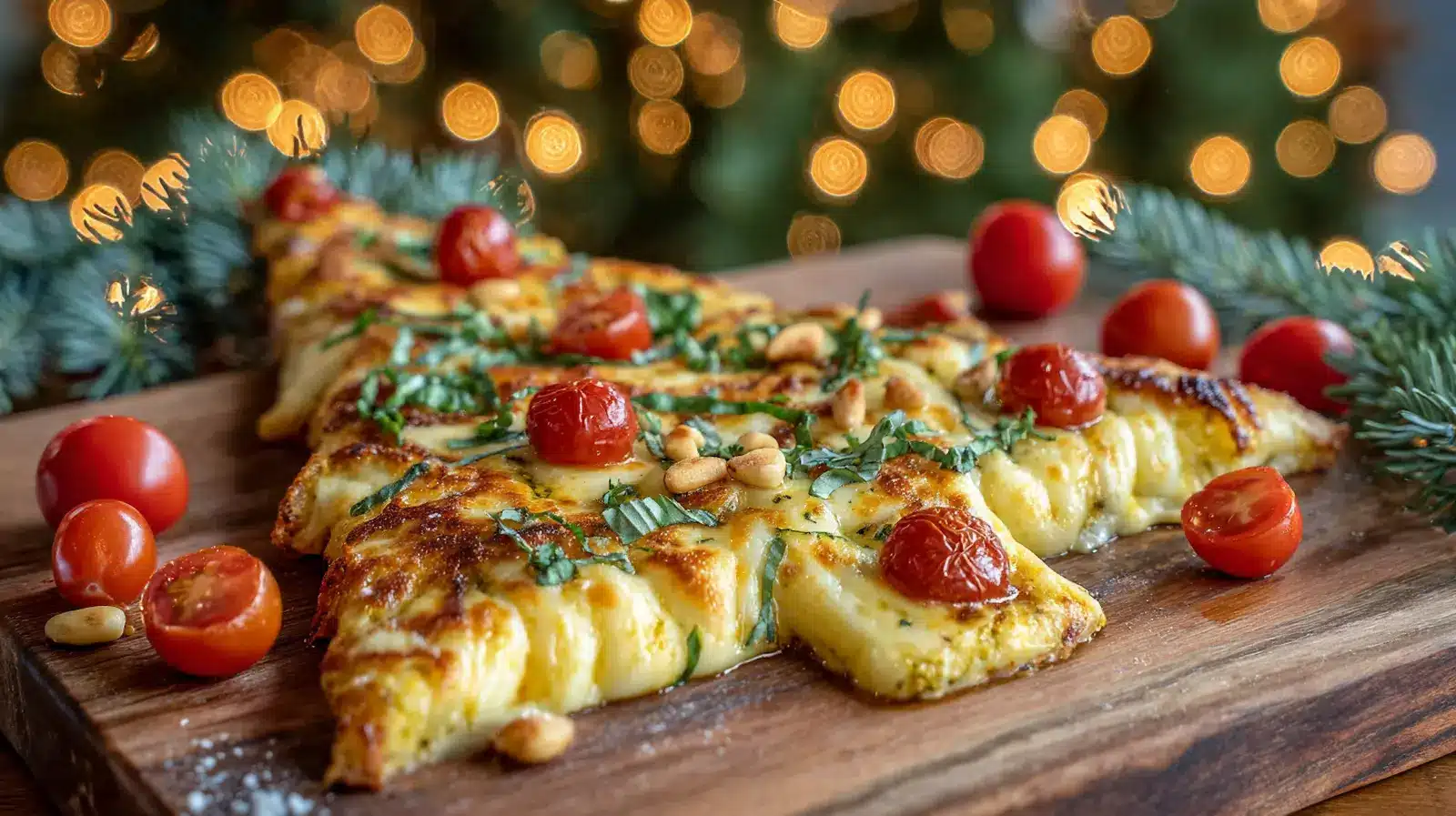
At its core, the Pesto Cheese Christmas Tree is a savory pastry shaped like a tree, layered or filled with pesto and cheeses that melt and crisp into contrasting textures. The two most common formats are:
- Baked puff pastry tree: sheets of puff pastry layered with pesto and shredded/soft cheeses, cut into a tree shape and twisted to form branches.
- No-bake cheese tree: a stacked, cone-shaped cheese ball or layers of softened cheeses coated in pesto and chopped herbs — perfect for cheese boards.
This recipe focuses on the baked puff pastry version because it scales easily, serves warm, and creates those crave-worthy flaky layers. The pastry tree is festive, portable, and makes a dramatic centerpiece before guests tear off the branches.
Why this works: hot, butter-rich puff pastry creates craggy, shatteringly crisp layers; pesto adds an herby, umami-rich bridge between dough and cheese; and choosing cheeses with complementary melt-and-brown behavior gives golden pockets of gooeyness.
The cooking logic: why puff pastry + pesto + cheese is a winning formula
Understanding the food science helps you predict outcomes and troubleshoot.
Puff pastry structure: Puff pastry is laminated dough — alternating layers of butter and dough. When baked, water in the butter and dough turns to steam and lifts layers, producing flaky lamination. Key variables: cold butter, cold dough, and hot oven. Over-handling or letting the butter melt will collapse lamination.
Cheese selection: Hard cheeses with lower moisture (Parmesan, aged Asiago) brown and develop nutty flavors without turning greasy. Melty cheeses with higher moisture (mozzarella, fontina, young cheddar) become stringy and smooth. Combining a melting cheese with a flavorful hard cheese gives both stretch and flavor.
Pesto role: Pesto is mostly oil, basil, nuts, garlic, and cheese. It acts as a flavor carrier (oil helps brown and crisp) and a moisture buffer between pastry layers. Pesto’s salt and umami intensify the cheese flavor. For oven safety, use a pesto that isn’t overloaded with watery ingredients — drain excess after making or use a thicker store-bought variety.
Egg wash: A thin egg wash on the pastry surface promotes deep golden color via Maillard reactions without saturating the dough.
Temperature: Oven at 400–425°F (200–220°C) is ideal. Too low and butter melts into dough; too high and the surface burns before layers fully lift.
These principles shape the step-by-step method below.
Print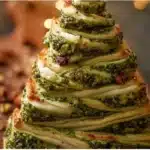
Pesto Cheese Christmas Tree
- Total Time: 40 minutes
- Yield: 8–12 servings 1x
- Diet: Vegetarian
Description
A show-stopping Pesto Cheese Christmas Tree—crispy puff pastry and melty cheeses layered with herbaceous pesto, perfect for holiday entertaining.
Ingredients
- 2 sheets puff pastry, thawed (all-butter preferred)
- 3/4 cup high-quality pesto (homemade or good-quality jar)
- 1 cup low-moisture shredded mozzarella
- 1/2 cup finely grated Parmesan or Pecorino
- 2–3 tablespoons cream cheese (softened, optional)
- 1 egg + 1 tbsp water (for egg wash)
- 2 tbsp toasted pine nuts or walnuts (optional)
- Flaky sea salt and cracked black pepper
- Red pepper flakes (optional)
Instructions
- Preheat oven to 400°F (200°C). Line a baking sheet with parchment.
- Lay one sheet of puff pastry on a lightly floured surface and trim to form a large triangle (about 10–12 inches tall). Repeat with second sheet for a smaller triangle to stack on top.
- If using cream cheese, spread a thin layer over the bottom pastry triangle as a moisture barrier. Spread 1/3–1/2 cup pesto evenly, leaving a 1/2-inch border.
- Scatter half the mozzarella and half the Parmesan over the pesto. If stacking, repeat with the smaller triangle.
- Cut slits on both sides of the triangle to create branches and twist each branch for a spiral effect.
- Transfer the tree to the baking sheet and brush lightly with egg wash.
- Sprinkle remaining Parmesan and pine nuts on top; season with flaky salt and cracked pepper.
- Bake for 18–22 minutes until deeply golden and puffed. If tips brown too quickly, tent with foil.
- Cool for 5 minutes, then serve warm.
Notes
Keep the puff pastry and butter cold during preparation for best lift. If using store-bought pesto, remove excess oil to prevent sogginess.
- Prep Time: 20 minutes
- Cook Time: 20 minutes
- Category: Appetizer
- Method: Baking
- Cuisine: Italian
Nutrition
- Serving Size: 1 serving
- Calories: 350
- Sugar: 2g
- Sodium: 450mg
- Fat: 25g
- Saturated Fat: 12g
- Unsaturated Fat: 10g
- Trans Fat: 0g
- Carbohydrates: 28g
- Fiber: 1g
- Protein: 10g
- Cholesterol: 40mg
Keywords: holiday appetizer, puff pastry, cheese, pesto, festive
Ingredients and why they matter
A short ingredient list can create spectacular results if each component is chosen and balanced.
- Puff pastry (2 sheets, thawed if frozen): Provides the flaky architecture. Use all-butter puff pastry where possible; it tastes better and browns more predictably.
- High-quality pesto (about 3/4 cup): Fresh basil pesto gives bright green color and aromatic lift. Homemade is best, but use a good jarred pesto if necessary.
- Shredded mozzarella (1 cup): The main melty component — mild, stretchy, and forgiving.
- Grated Parmesan or Pecorino (1/2 cup): Adds umami, salt, and helps with browning.
- Cream cheese or ricotta (2–3 oz, optional): Adds tang and helps bind the layers in a no-bake version; in the baked version a thin layer helps moisture control.
- Egg (1, beaten with 1 tbsp water): For egg wash to produce a glossy brown finish.
- Pine nuts or chopped toasted walnuts (2 tbsp, optional): For texture and to mirror pesto flavors when sprinkled on top.
- Red pepper flakes, flaky sea salt, cracked black pepper: Seasoning layers.
- Optional extras: sun-dried tomatoes, prosciutto slices, caramelized onions, roasted red peppers.
Ingredient science notes:
- Use low-moisture shredded mozzarella for less steam and optimal flakiness.
- If using store-bought pesto, blot it with a paper towel to remove excess oil; too much oil will dampen the pastry.
- Toast any nuts briefly to release oils and deepen flavor.
If you enjoy baking savory items that combine cheese and vegetables, try baking them alongside these cheese-forward bites — for example, our Cheese Pumpkin Muffins make a surprising sweet-savory pairing for fall-to-winter gatherings.
Tools and prep checklist
Before you start: mise en place is crucial. Gather these tools:
- Baking sheet lined with parchment
- Sharp chef’s knife or pizza cutter
- Pastry brush
- Rolling pin (optional)
- Cooling rack
- Baking weights if blind-baking (not necessary here)
- Small bowl for egg wash
- Large spoon or offset spatula for spreading pesto
Prep steps:
- Thaw puff pastry in refrigerator overnight or on counter for 30–60 minutes until flexible but still cool.
- Preheat oven to 400–425°F (200–220°C).
- Grate cheeses and measure the pesto.
- Line baking sheet with parchment and lightly flour your surface.
- Chill assembled pastry briefly if butter softens during shaping.
Recipe card: Pesto Cheese Christmas Tree (Baked Puff Pastry)
Yields: Serves 8–12 as an appetizer
Prep time: 20 minutes (plus 30 minutes chilling)
Cook time: 18–22 minutes
Total time: ~1 hour
Ingredients:
- 2 sheets puff pastry, thawed (all-butter preferred)
- 3/4 cup pesto (homemade or good-quality jar)
- 1 cup low-moisture shredded mozzarella
- 1/2 cup finely grated Parmesan or Pecorino
- 2–3 tablespoons cream cheese (softened, optional)
- 1 egg + 1 tbsp water (for egg wash)
- 2 tbsp toasted pine nuts or walnuts (optional)
- Flaky sea salt and cracked black pepper
- Red pepper flakes (optional)
Method:
- Preheat oven to 400°F (200°C). Line a baking sheet with parchment.
- Lay one sheet of puff pastry on a lightly floured surface. Using a sharp knife or pizza cutter, trim to form an approximate large triangle (this will be the main tree shape — about 10–12 inches tall). Repeat with second sheet, slightly smaller triangle to stack on top if you want more height.
- If using cream cheese, spread a thin layer over the bottom pastry triangle as a moisture barrier. Spread 1/3–1/2 cup pesto evenly on the pastry triangle, leaving a 1/2-inch border.
- Scatter half the mozzarella and half the Parmesan evenly over the pesto. If stacking two layers, repeat with the smaller triangle.
- Using a knife, cut slits on both sides of the triangle (from base to near the top) to create branches — 8–10 cuts per side depending on size. Twist each branch away from the center 1–2 full rotations for a spiral effect that exposes cheese and creates gaps for crisping.
- Transfer the tree to the parchment-lined sheet using the parchment under the pastry or a wide spatula. Brush lightly with egg wash.
- Sprinkle remaining Parmesan and pine nuts on top; season with flaky salt and cracked pepper.
- Bake 18–22 minutes until deeply golden and puffed. If tips brown too quickly, tent loosely with foil.
- Cool 5 minutes on the sheet, then transfer to a rack. Serve warm so the cheese strings and the pesto aroma shine.
Chef note: For single-sheet simplicity, cut one large triangle and fold a narrow strip at the top to create a trunk effect, then proceed with cuts and twists.
Advanced technique and pro tips
- Keep everything cold. The butter in puff pastry must remain solid until it hits hot oven. If your hands warm the dough while twisting branches, pop the shaped tree into the fridge for 15–30 minutes before baking.
- Thinner pesto layer = crisper pastry. Pesto is delicious but watery pesto or too much oil will make the pastry soggy. Dab excess oil off with a paper towel before spreading.
- Use a microplane for the hard cheese. Finely grated Parmesan distributes flavor and browns more evenly.
- Twisting technique matters. Each branch should be twisted away from the center, exposing layers while keeping the base intact. Twisting too tightly will compress the layers and reduce lift.
- Egg wash: use a light brush — excessive egg makes a thick crust that might mask lamination.
- Hot oven and stone: a preheated baking stone or steel gives immediate heat, enhancing lift. If you have a baking stone, place the tree directly on parchment on top of it.
- Browned cheese on top = flavor advantage. If the cheese isn’t browning enough by mid-cook, switch to broil for 30–60 seconds watching carefully.
Common mistakes to avoid:
- Letting the pastry get too warm while shaping.
- Overloading pesto or wet toppings that create steam pockets.
- Cutting branches too narrow — they’ll collapse instead of puffing.
- Baking at too low a temperature: pastry will absorb fat and deflate.
Variations and swaps
The Pesto Cheese Christmas Tree is a template — use it to explore flavor profiles and dietary needs.
Savory variations:
- Prosciutto & Fig: Spread fig jam (thin layer), top with shredded fontina, and add thin prosciutto strips between layers for a sweet-salty profile.
- Sun-Dried Tomato & Basil: Replace pesto with sun-dried tomato tapenade and swap mozzarella for provolone.
- Caramelized Onion & Gruyère: Sauté onions until golden and sweet, layer with gruyère for a rich, complex tree.
Dietary swaps:
- Gluten-free: Use a good-quality gluten-free puff pastry (found in specialty stores). Be aware that GF pastry behaves differently — handle gently and keep thoroughly chilled.
- Vegan: Use vegan puff pastry (dairy-free) and a cashew-based pesto or basil oil. Swap mozzarella for a plant-based melting cheese; choose a higher-fat vegan cheese for better melt.
- Low-calorie pesto: Make lighter pesto by swapping much of the oil with blanched spinach and Greek yogurt (see low-calorie pesto ideas on our site — low-cal pesto tweaks reduce oil but keep flavor). This makes the tree less oily but keep the layer thin.
Serve-with pairings:
- For a cheesy-sweet combination, a tart or bright dessert works well after this rich appetizer — try finishing the meal with something like our Caramel Apple Cheesecake to contrast the herb-forward starter.
No-bake Pesto Cheese Christmas Tree (cheese-board version)
If you prefer cold appetizers or want an immediately sliceable centerpiece, make a stacked cheese tree.
Ingredients:
- 8 oz cream cheese, softened
- 6 oz goat cheese or ricotta
- 1/2 cup pesto (thicker)
- 1/4 cup grated Parmesan
- Chopped herbs: basil, chives, parsley
- Cherry tomatoes, olives, or pomegranate seeds for decoration
Method:
- Mix cream cheese and goat cheese with pesto and Parmesan until spreadable.
- Build layers by spooning onto a cone-shaped mold (or shape with cling film), compacting each layer. Chill for 1–2 hours to firm.
- Unmold, coat with chopped herbs and decorate like a tree. Serve with crostini or crackers.
Pro tip: Brush the outside lightly with oil and roll in herbs so slices don’t dry out.
Plating and presentation ideas
A festive presentation boosts perceived value.
- Serve the baked tree on a wooden board with small bowls of extra pesto and marinara for dipping.
- Garnish with fresh basil leaves, cherry tomato “ornaments,” and edible flowers for a colorful finish.
- For a grazing table, place the no-bake cheese tree as the center and surround with cured meats, dried fruits, olives, and artisanal crackers.
- Make bite-sized trees by cutting small triangles and folding once — faster for cocktail parties.
Storage, make-ahead, and reheating
Make-ahead strategies help hosts relax.
- Assembled but unbaked: You can shape the pastry tree, cover, and refrigerate for up to 24 hours. For best lift, bake directly from chilled.
- Baked tree: Store in an airtight container at room temperature for up to 24 hours. After 24 hours, keep refrigerated and consume within 2 days.
- Reheating: For best texture, reheat in a 375°F (190°C) oven for 6–8 minutes to crisp the pastry back up. Avoid microwaving — it makes pastry gummy.
- No-bake cheese tree: Keep refrigerated and covered; serve within 3–4 days. Remove from fridge 20 minutes before serving for best texture.
Leftovers:
- Shred leftover baked tree and fold into a frittata or omelette for an instant breakfast upgrade.
- Crumble leftover pastry into salads as crunchy croutons (use within 48 hours).
Nutrition insights
Exact nutrition depends on puff pastry brand and amount of cheese/pesto used. A rough estimate per serving (1/8th of the baked tree):
- Calories: ~320–380 kcal
- Fat: 22–28 g (mostly from butter in pastry and oil in pesto)
- Saturated fat: 9–12 g
- Protein: 8–10 g
- Carbohydrates: 18–24 g
- Sodium: Moderate to high (depending on pesto and cheese)
Health trade-offs and tips:
- Choose an all-butter pastry for flavor; if watching saturated fat, use a smaller portion and pair with lots of fresh veggies on the grazing board.
- Make a lighter pesto (more greens, less oil) to reduce overall fat without losing herb flavor.
- Add tomato and cucumber sides to increase fiber and lower the per-serving calorie density when guests plate their bites.
If you’re following specific dietary goals, scale portion size and pair with lighter sides or a robust vegetable soup like our hearty options.
Frequently Asked Questions (FAQ) — schema-ready
Q: Can I use frozen puff pastry straight from the freezer?
A: Thaw it until flexible in the refrigerator overnight or on the counter for about 30–60 minutes. You want it pliable but still cold. Working with pastry that is too frozen can lead to tearing; too warm will collapse the layers.
Q: What is the best cheese for melting in this recipe?
A: Low-moisture mozzarella and fontina are excellent for stretch and melt. Blend with a hard cheese like Parmesan for flavor and browning.
Q: My pastry didn’t puff—what went wrong?
A: Most likely the butter melted before baking. Chill the shaped pastry and ensure your oven is preheated to the right temperature. Avoid overworking the dough.
Q: Can I make mini trees for a party tray?
A: Yes. Cut smaller triangles and twist fewer branches. Reduce bake time slightly and watch closely for browning.
Q: How do I keep the pesto from making the pastry soggy?
A: Use a thin layer of pesto, blot excess oil, or add a thin layer of cream cheese or grated hard cheese as a moisture barrier before spreading pesto.
Q: Is this recipe freezer-friendly?
A: You can freeze shaped, unbaked trees for up to 1 month. Freeze on a tray until firm, then wrap tightly. Bake from frozen, adding a few extra minutes to the bake time.
Q: Can I make this dairy-free?
A: Use vegan puff pastry and plant-based cheeses designed to melt. Use a pesto made without cheese (nut/leaf-based with nutritional yeast) for flavor.
Q: How should I store leftovers?
A: Keep at room temperature up to 24 hours, then refrigerate and consume within 2–3 days. Re-crisp in a hot oven before serving.
Troubleshooting quick guide
- Pastry soggy at center: Next time, use a thinner pesto layer and preheat baking stone; keep ingredients cold.
- Branches won’t stay twisted: Use a gentle outward twist and briefly chill the shaped tree before baking.
- Cheese leaks and burns: Use lower-fat hard cheese or scatter cheese more internally; tent with foil if edges over-brown.
- Pale top: Increase oven temperature slightly or finish with a 20–30 second broil, watching carefully.
Final notes and entertaining strategy
The Pesto Cheese Christmas Tree is more than a recipe — it’s a hospitality shortcut. Make it your centerpiece and you’ll get reactions, not just compliments. Use the no-bake version as a weekend grazing highlight and the baked version when you want warm, melty goodness. Keep the pesto layer conservative, keep your pastry cold, and trust the oven to deliver drama.
Conclusion
If you want a tested, beautiful appetizer that’s both festive and satisfying, the Pesto Cheese Christmas Tree is a winner. For an alternate puff pastry method and additional step-by-step photos, you can explore the recipe roundup for similar techniques at “Puff Pastry Pesto Christmas Trees” on Cooking My Dreams and another clear tutorial on “Pesto Puff Pastry Christmas Trees” from Dished by Kate — both offer visual variations that complement this guide and are great references if you want to adapt shapes or fillings.
- Puff Pastry Pesto Christmas Trees – Cooking My Dreams
- Pesto Puff Pastry Christmas Trees – Dished by Kate
Enjoy building your tree, and if you try an inventive twist, share a photo and recipe notes so other hosts can borrow your idea.