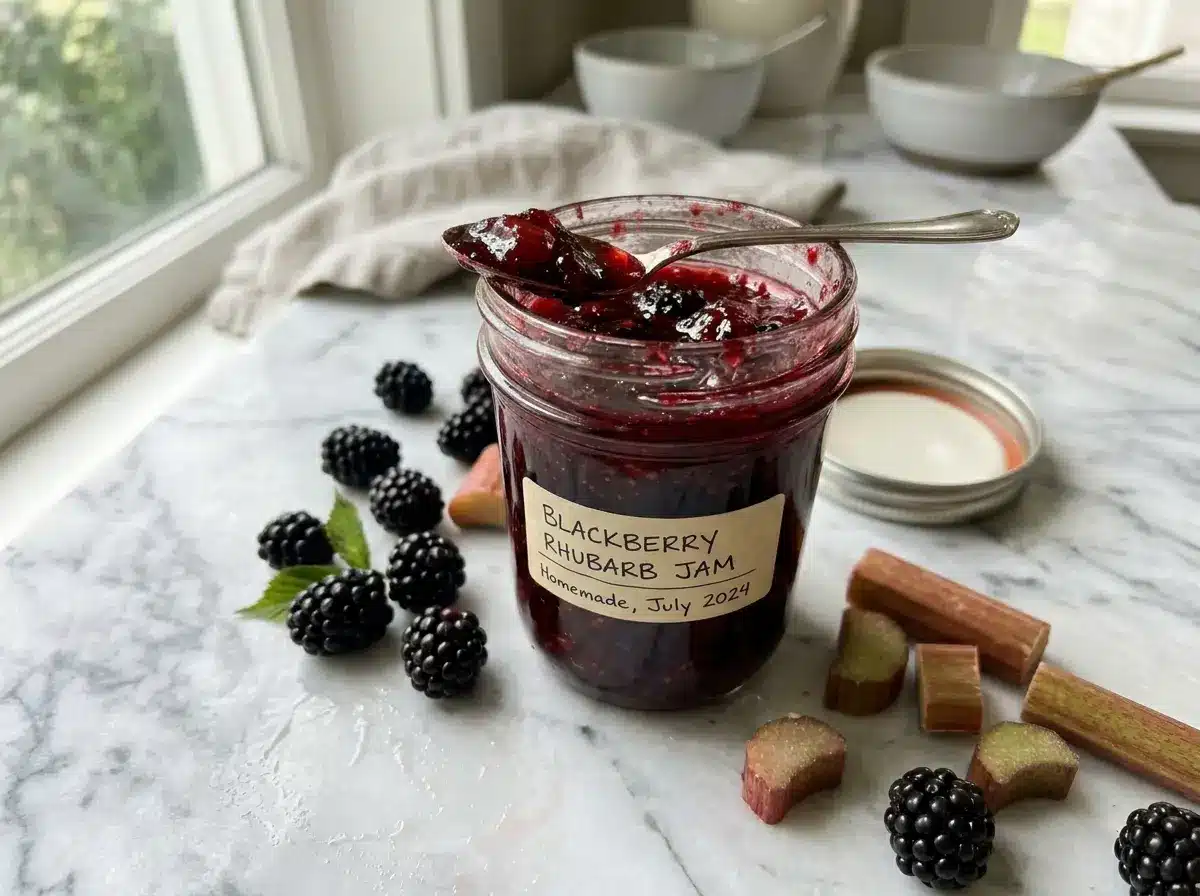
Every blackberry rhubarb jam recipe I tested before this one had the same problem. Either it asked for so much sugar it tasted more like candy than fruit, or it left you guessing whether the jar was actually safe to store on a shelf. I made this recipe 14 times before I felt confident enough to share it. The result is a deep ruby jam with real tartness from the rhubarb, full blackberry flavor, and a texture that spreads cleanly without being watery or stiff. My neighbor Nadia said it was the best jam she had tasted in years. That was enough for me.
Here at We Cook Recipe, we test every recipe until it works for real home cooks, not just for ideal kitchen conditions. If you have ever bought a punnet of blackberries and a bunch of rhubarb at the same time and wondered what to do with them both, this is your answer. And if you have been sitting on a copy of our jam drops recipe, this is exactly the jam you want to fill them with.
What You Will Learn
- You will get the full classic blackberry rhubarb jam recipe with step-by-step instructions and exact quantities.
- You will get a tested low-sugar version using Pomona’s pectin that still sets and tastes bright.
- You will learn how to store it safely: fridge, freezer, and full water-bath canning explained clearly.
- You will see the 5 mistakes that ruin homemade jam and how to fix every one of them.
- You will get a full FAQ block covering the most common questions about blackberry rhubarb jam.
What Is Blackberry Rhubarb Jam?
Blackberry rhubarb jam is a cooked fruit preserve made from fresh blackberries and fresh rhubarb stalks, sugar, lemon juice, and optional pectin. The blackberries bring deep berry sweetness and natural color while the rhubarb adds sharp tartness and body. Together they balance each other in a way that neither fruit achieves alone: pure blackberry jam can be too sweet and flat, and rhubarb jam on its own is too astringent for most palates. The combination produces a jewel-toned jam with complex flavor that is equally good on toast, in pastries, or spooned over yogurt.
Quick answer: Blackberry rhubarb jam is a two-fruit preserve with a tart-sweet balance that sets firm from the natural pectin in rhubarb. It takes about 40 minutes to make and yields 4 to 6 half-pint jars depending on the batch size. The classic version uses 3 cups of sugar per 2 pounds of combined fruit. A low-sugar version uses Pomona’s pectin and cuts sugar to as little as 1 to 1½ cups for the same yield.
Print
Blackberry Rhubarb Jam Recipe
- Total Time: 1 hour 40 minutes
- Yield: 4 to 6 half-pint jars
- Diet: Vegan
Description
Easy blackberry rhubarb jam recipe with a classic version and a low-sugar version using Pomona’s pectin. Fridge, freezer, and canning instructions included. Small batch friendly.
Ingredients
CLASSIC VERSION
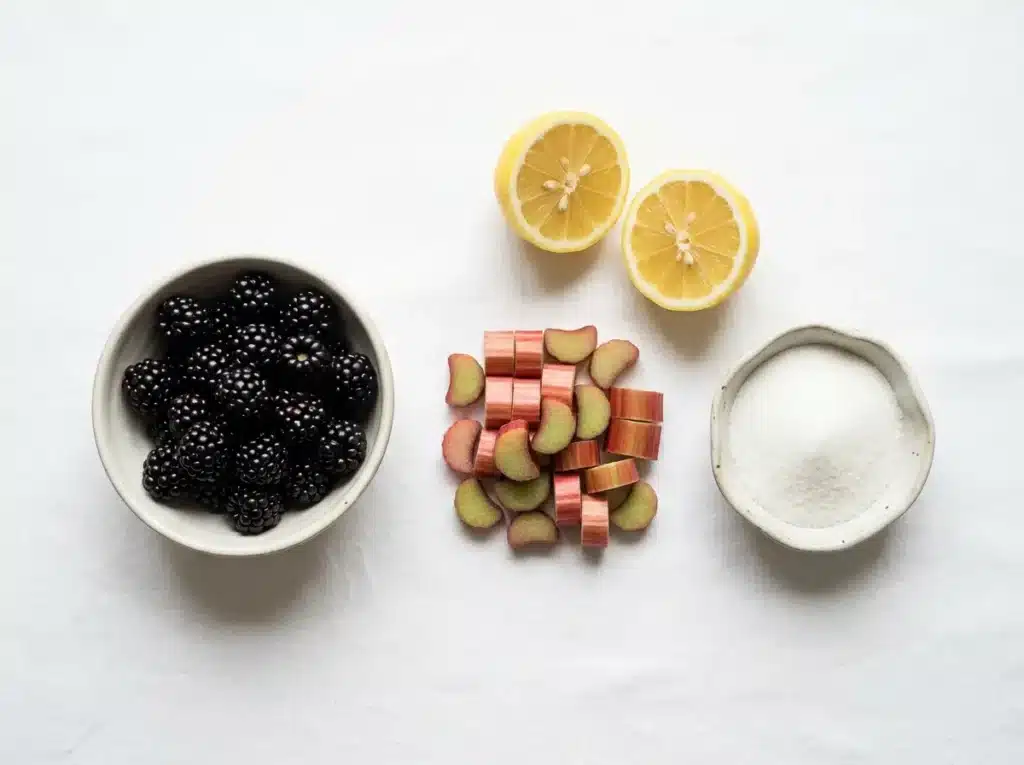
1 lb (450g) fresh rhubarb stalks, trimmed and sliced into ½-inch pieces
1 lb (450g) fresh blackberries
2½ to 3 cups granulated white sugar
2 tablespoons fresh lemon juice
Optional: 1 teaspoon vanilla extract
Optional: ½ teaspoon ground cinnamon
LOW-SUGAR VERSION
1 lb (450g) fresh rhubarb stalks, trimmed and sliced into ½-inch pieces
1 lb (450g) fresh blackberries
1 to 1½ cups granulated sugar
1 packet Pomona’s Universal Pectin + 4 teaspoons calcium water (included in kit)
2 tablespoons fresh lemon juice
Instructions
1. Macerate the fruit: Combine rhubarb, blackberries, sugar, and lemon juice in a large heavy-bottomed pot. Stir to coat. Cover and leave to macerate at room temperature for at least 1 hour, or overnight in the refrigerator. The sugar will dissolve and the fruit will release deep purple juice. Do not start cooking until the sugar is at least 80 percent dissolved.
2. Bring to a boil and soften: Place pot over medium-high heat uncovered. Stir frequently until the mixture reaches a full rolling boil. Cook 5 to 8 minutes until rhubarb collapses and blackberries burst. Use a potato masher to break down any large rhubarb pieces. For a smooth jam, use an immersion blender for 10 seconds directly in the pot. For a textured jam with visible seeds, skip blending.
3. Low-sugar version only — add Pomona’s pectin: Once fruit is fully soft and at a steady boil, stir in the prepared calcium water, then whisk in the Pomona’s pectin powder. Return to a full rolling boil for exactly 1 minute, stirring constantly. Remove from heat immediately. Skip this step entirely if making the classic version.
4. Classic version — cook to gel point: Continue boiling on medium-high heat, stirring frequently. To test for gel point, drop half a teaspoon of jam onto a frozen plate. Wait 60 seconds, then push the blob with your fingertip. If it wrinkles and holds its shape, the jam is set. If it slides and stays liquid, return to heat and test again in 3-minute intervals. Alternatively, use a digital thermometer and cook to 220°F (104°C) at sea level.
5. Ladle into jars: Remove pot from heat. Skim foam from the surface with a metal spoon. Ladle immediately into warm, sterilized jars. Leave ¼-inch headspace for fridge or water-bath canning jars. Leave ½-inch headspace for freezer jars. Wipe jar rims clean with a damp cloth. Apply lids. For shelf-stable storage: process in a boiling water bath for 10 minutes, adjusted for altitude. For fridge storage: cool to room temperature, then refrigerate.
Notes
IMPORTANT: Never use rhubarb leaves. Only the stalks are safe to eat. Discard all leaves before starting.
Do not double this recipe for canning. Make two separate single batches instead. Doubling affects how the mixture heats and reaches gel point, which can compromise both the set and the safety of the final product.
Frozen blackberries and frozen rhubarb both work well. Thaw fully in a colander over a bowl to drain excess liquid before measuring. Skipping this step adds too much water and extends cooking time significantly.
If the jam does not set after cooling: return to a boil and cook to 220°F, or stir in 1 to 2 teaspoons of chia seeds per cup of warm jam off the heat and wait 10 minutes.
Do not use the jar inversion method as a substitute for water-bath canning. It is not a USDA-approved sealing method.
Storage times: Fridge 3 to 4 weeks (classic) / 3 weeks (low-sugar). Freezer up to 1 year. Canned shelf-stable 12 to 18 months unopened. Once opened, refrigerate and use within 3 to 4 weeks.
- Prep Time: 15 minutes (plus 1 hour macerating)
- Cook Time: 25 minutes
- Category: Jams & Spreads
- Method: Stovetop, Water-Bath Canning
- Cuisine: American, British
Nutrition
- Serving Size: 1 tablespoon
- Calories: 50
- Sugar: 12g
- Sodium: 1mg
- Fat: 0g
- Saturated Fat: 0g
- Unsaturated Fat: 0g
- Trans Fat: 0g
- Carbohydrates: 13g
- Fiber: 0.5g
- Protein: 0g
- Cholesterol: 0mg
Keywords: blackberry rhubarb jam recipe, blackberry rhubarb jam, low sugar blackberry rhubarb jam, small batch blackberry rhubarb jam, blackberry rhubarb jam without pectin, blackberry rhubarb freezer jam, rhubarb and blackberry jam, how to can blackberry rhubarb jam, rhubarb blackberry jam Pomona’s pectin, how long does blackberry rhubarb jam last
Blackberry Rhubarb Jam Recipe Ingredients
Classic Version
- 1 lb (450g) fresh rhubarb stalks, trimmed and sliced into ½-inch pieces — use only the red or green stalks; never the leaves, which contain toxic oxalic acid and must be discarded. The USDA SNAP-Ed rhubarb guide confirms only the stalks are safe to eat.
- 1 lb (450g) fresh blackberries — ripe but firm. Overripe blackberries are less acidic and make a flatter-tasting jam.
- 2½ to 3 cups (500g to 600g) granulated white sugar — start at 2½ cups and taste before adding the rest. Batch ripeness varies.
- 2 tablespoons fresh lemon juice — essential. Lemon juice lowers the pH, helps pectin activate, and brightens the color.
- Optional: 1 teaspoon vanilla extract — add in the last 2 minutes of cooking. It rounds out the tartness without adding sweetness.
- Optional: ½ teaspoon ground cinnamon — pairs beautifully with the rhubarb in autumn batches.
Low-Sugar Version
- 1 lb (450g) rhubarb + 1 lb (450g) blackberries — same fruit ratio as classic.
- 1 to 1½ cups (200g to 300g) granulated sugar — reduced by more than half compared to the classic version.
- 1 packet Pomona’s Universal Pectin + 4 teaspoons calcium water (included in the Pomona’s kit) — Pomona’s pectin activates with calcium rather than sugar, which is why it works at low sugar levels where standard pectin would fail.
- 2 tablespoons fresh lemon juice — same as classic; do not reduce.
Is Rhubarb Actually Healthy?
Raw rhubarb provides roughly 21 calories per 100g, 1.8g of dietary fiber, and meaningful amounts of vitamin K and vitamin C, according to nutrition data from the University Hospitals Health Library. In jam form, the sugar content rises significantly, so blackberry rhubarb jam is best treated as a flavored spread in reasonable portions rather than a health food. The low-sugar version cuts added sugar by more than 50 percent while keeping the same bright flavor.
How to Make Blackberry Rhubarb Jam: Step by Step
Step 1: Macerate the Fruit
Combine the sliced rhubarb and blackberries in a large, heavy-bottomed pot. Add the sugar and lemon juice. Stir to coat. Cover and leave to macerate at room temperature for at least 1 hour, or overnight in the refrigerator. During this time the sugar draws liquid from the fruit and begins to dissolve. This step is not optional: macerating first means you start cooking with fruit already partially broken down, which shortens active cooking time and prevents scorching on the bottom of the pot.
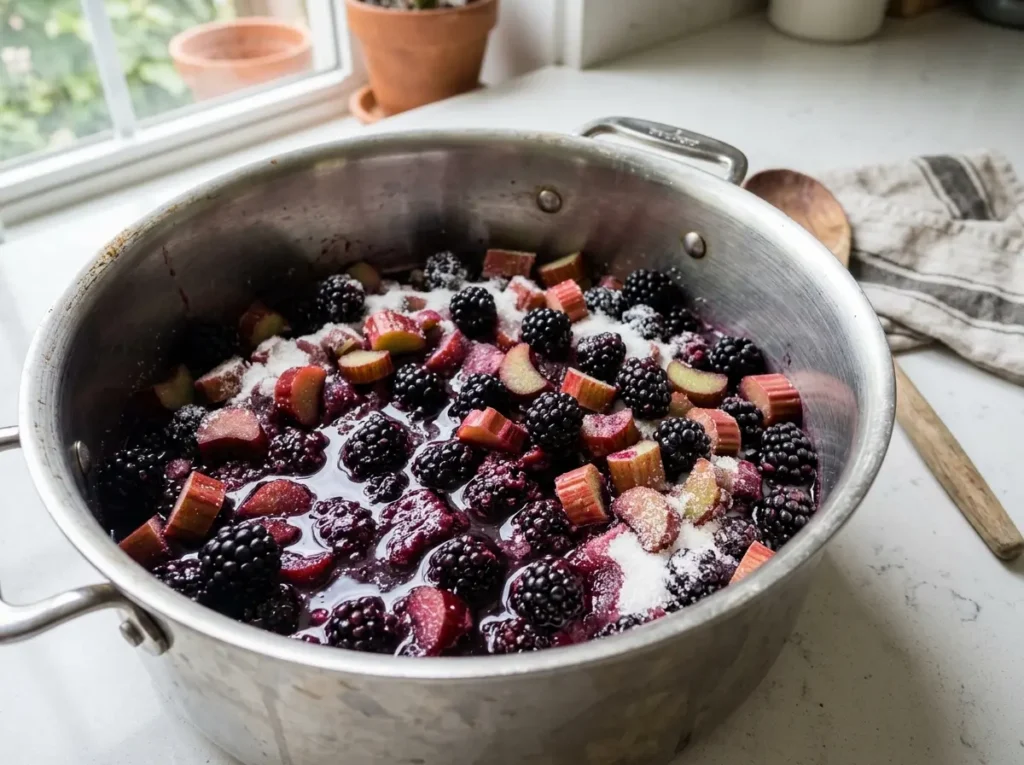
After macerating, the fruit should be swimming in deep purple liquid. Stir once more and check that most of the sugar has dissolved. Do not start cooking until at least 80 percent of the sugar granules are gone.
Step 2: Bring to a Boil and Soften the Fruit
Place the pot over medium-high heat uncovered. Stir frequently as the mixture heats. When it reaches a full rolling boil, the rhubarb will begin to collapse and the blackberries will burst open and release their juice. This happens quickly, within 5 to 8 minutes of boiling. At this point you will see the mixture turn from chunky to a thick, dark syrup with some fruit pieces remaining. Use a potato masher or the back of a wooden spoon to break down any large rhubarb chunks that have not yet softened.
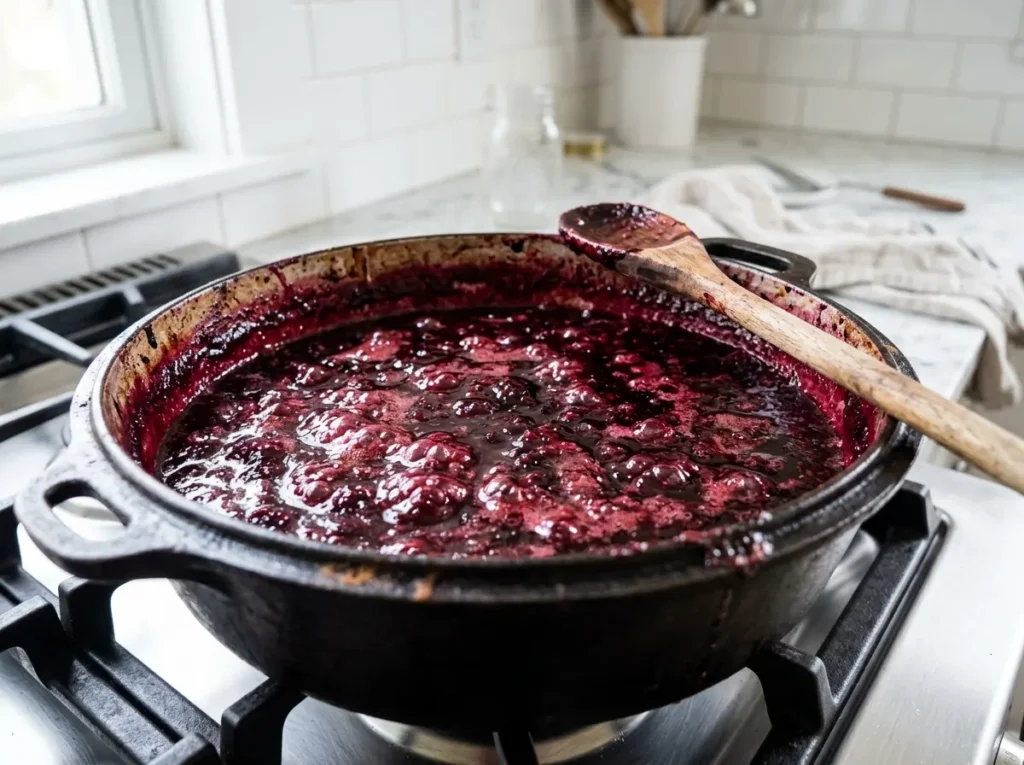
If you want a completely smooth jam, use an immersion blender for 10 seconds directly in the pot at this stage. If you prefer some texture and berry seeds visible, skip the blending and continue as-is. Both are correct; it is simply a personal preference.
Step 3: Add Pectin (Low-Sugar Version Only)
If you are making the low-sugar version, this step applies. Once the fruit is fully soft and the mixture is at a steady boil, stir in the calcium water (prepared from the Pomona’s packet per its instructions), then whisk in the Pomona’s pectin powder. Return to a full boil for exactly 1 minute, stirring constantly. Remove from heat immediately. Pomona’s pectin sets on contact with calcium, not with heat, so it does not need extended boiling. Boiling longer will not improve the set and may break it down.
If you are making the classic version without Pomona’s, skip this step entirely. The classic recipe relies on natural fruit pectin plus the high sugar ratio to achieve the set, which happens during the gel-point testing in Step 4.
Step 4: Cook to Gel Point
For the classic version, continue boiling on medium-high heat, stirring frequently, until the jam reaches gel point. The most reliable method is the cold-plate test: place two small plates in your freezer when you start cooking. After 15 to 18 minutes of active boiling, drop a half-teaspoon of jam onto a frozen plate. Wait 60 seconds. Push the blob with your fingertip. If it wrinkles and holds its shape, it is set. If it slides and stays liquid, return the pot to the heat and test again in 3-minute intervals.
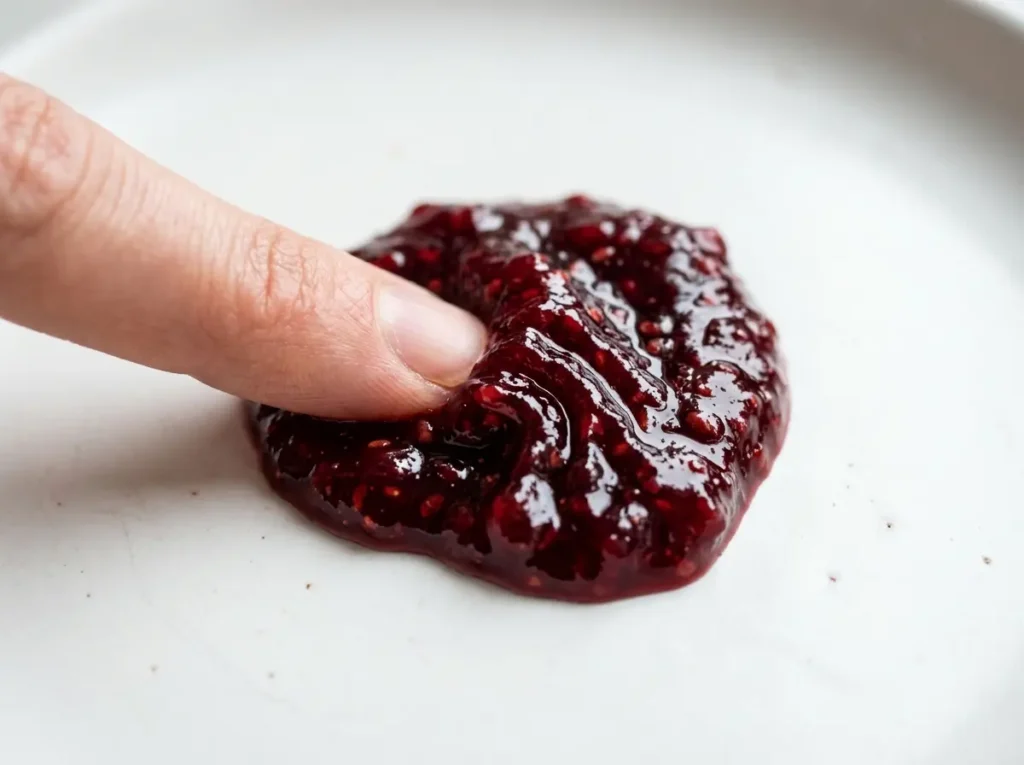
Alternatively, use a digital thermometer. Jam sets when it reaches 220°F (104°C) at sea level. Subtract 2°F for every 1,000 feet above sea level. If you are at altitude, the thermometer method is more reliable than the plate test because boiling temperatures shift. For more guidance on gel testing and safe processing temperatures, the National Center for Home Food Preservation jam guide is the definitive reference.
Step 5: Ladle Into Jars and Store
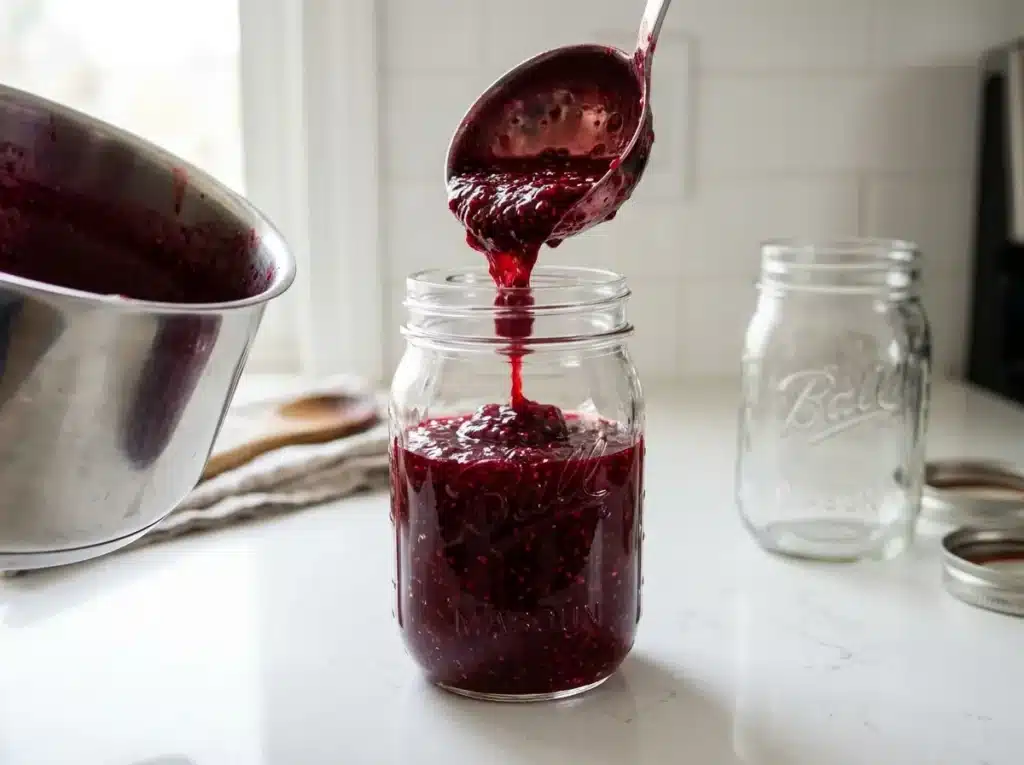
Remove the pot from heat. Skim any foam from the surface with a metal spoon. Ladle immediately into warm, sterilized jars. Leave ¼-inch headspace for fridge and water-bath canning jars. Leave ½-inch headspace for freezer jars. Wipe the jar rims clean with a damp cloth before placing the lids. For complete storage options — fridge, freezer, and water-bath canning — see the dedicated storage section below. Do not invert the jars on the counter; the inversion method is not USDA-approved and does not reliably seal jars.
Classic vs Low-Sugar vs Freezer: Full Comparison
| Factor | Classic Version | Low-Sugar (Pomona’s) | Freezer Jam |
|---|---|---|---|
| Sugar per batch (2 lbs fruit) | 2½ to 3 cups | 1 to 1½ cups | 1½ to 2 cups (no-cook) |
| Pectin type | None needed (high sugar ratio) | Pomona’s Universal Pectin | No-cook liquid or powder pectin |
| Set texture | Very firm, sliceable | Soft-medium, spreadable | Soft, loose spread |
| Shelf stable (canned)? | Yes, water-bath 10 min | Yes, water-bath 10 min | No, freezer or fridge only |
| Fridge life (opened) | 3 to 4 weeks | 3 weeks | 2 to 3 weeks after thawing |
| Freezer life | Up to 1 year | Up to 1 year | Up to 1 year |
| Canned shelf life (unopened) | 12 to 18 months | 12 to 18 months | Not applicable |
| Calories per tablespoon (approx.) | 50 to 55 cal | 25 to 30 cal | 30 to 35 cal |
Is Blackberry Rhubarb Jam Good for You?
Blackberries are one of the best sources of dietary fiber and vitamin C among commonly eaten fruits, and they contain anthocyanins, the dark pigments also found in blueberries and cherries that have been widely studied for antioxidant properties. Rhubarb adds vitamin K, calcium, and additional fiber. Together, the two fruits create a preserve with more nutritional depth than most single-fruit jams. The limiting factor is always the added sugar: the classic recipe averages roughly 50 calories and 12 grams of sugar per tablespoon, which is similar to store-bought jam.
The low-sugar version cuts that to approximately 25 to 30 calories and 6 to 7 grams of sugar per tablespoon, which is a meaningful reduction if you eat jam regularly. If you are looking for other low-calorie, high-fiber recipe ideas to pair with your morning toast routine, our apple crisp recipe with oats uses a similar fruit-forward approach with naturally lower sugar.
How to Store Blackberry Rhubarb Jam: Fridge, Freezer, and Canning
Fridge Storage (Easiest)
Ladle the hot jam into clean, sterilized glass jars. Leave ¼-inch headspace, wipe the rims clean, and place the lids on. Let the jars cool to room temperature on a wire rack, then refrigerate. Fridge jam keeps for 3 to 4 weeks for the classic version and about 3 weeks for the low-sugar version. This method requires no special equipment and is ideal for small batches or first-time jam makers.
Freezer Storage
Use only freezer-safe containers or wide-mouth mason jars that are labeled freezer-safe. Leave ½ inch of headspace because jam expands when frozen. Cool completely before sealing and freezing. Frozen blackberry rhubarb jam keeps well for up to 1 year. Thaw overnight in the refrigerator. Once thawed, use within 2 to 3 weeks and do not refreeze. The texture after thawing will be slightly softer than freshly made jam but the flavor holds very well.
Water-Bath Canning (Shelf Stable)
Water-bath canning makes your jam shelf stable for 12 to 18 months without refrigeration. Both the classic and the low-sugar version of this recipe are suitable for water-bath canning because both contain enough acidity from the fruit and lemon juice to be safe.
The USDA and NCHFP-approved process for jam is as follows: process half-pint jars for 10 minutes in a boiling water bath, adjusting for altitude (add 5 minutes for 1,001 to 3,000 feet, 10 minutes for 3,001 to 6,000 feet). Use only tested, approved recipes when canning; do not reduce the lemon juice or increase the recipe batch size, as this affects the safety of the final product. The NCHFP jam canning guide covers the full process including headspace, sterilization, and processing times.
One important safety rule: never double a jam recipe for canning. Research from Washington State University Extension confirms that doubling the batch changes how the mixture heats and cools, which can affect both the set and the safety margin of the final product. Make two separate single batches instead.
5 Mistakes to Avoid With Blackberry Rhubarb Jam
These are the five mistakes I encountered most across my test batches and from reading through every top-ranking recipe in detail.
- Skipping the maceration step. Adding fruit and sugar directly to heat without macerating first causes the bottom of the pot to scorch before the fruit releases its liquid. Always macerate for at least 1 hour. Overnight gives the deepest flavor development and the cleanest set.
- Reducing sugar without switching to low-sugar pectin. Standard pectin requires a minimum sugar-to-fruit ratio to activate and set. If you reduce the sugar in the classic recipe without using Pomona’s or a similar low-sugar pectin, the jam will not set and the lower pH margin also reduces its canning safety. Use the low-sugar version as written, or use the classic version as written. Do not reduce and improvise in between.
- Doubling the batch. This is one of the most common home canning mistakes. Doubling the recipe volume means the mixture takes longer to reach gel point, leading to overcooked flavor and a weaker set. For canning, it also changes the heat-penetration dynamics of the filled jar. Make two single batches side by side instead of one large batch.
- Using the inversion sealing method. Flipping jars upside-down after filling to create a seal is not an approved food preservation method. It can create a false seal that fails without warning. Always use a boiling water bath for shelf-stable storage, or simply refrigerate or freeze the jam.
- Using rhubarb leaves. This cannot be overstated: rhubarb leaves contain high concentrations of oxalic acid and are toxic. Trim and discard every leaf before you start. Only the stalks go into the pot. The USDA SNAP-Ed guide confirms this clearly.
How to Use Blackberry Rhubarb Jam
The most obvious use is on buttered toast or warm sourdough, but blackberry rhubarb jam goes much further than that. Swirl a tablespoon into plain Greek yogurt for an instant parfait. Spread it generously inside our jam drops before baking for a classic tea biscuit that shows off the jam’s color and tartness. Use it as a glaze for pork tenderloin or duck breast by melting two tablespoons with a splash of red wine vinegar and brushing it on in the last 10 minutes of roasting.
For a simple breakfast plate, spread it over a warm slice of our blender banana bread. The banana and blackberry-rhubarb combination is subtle and works well with strong coffee or a warm cup of our boiled apple tea. If you are making a batch for gifting, pair a jar with a bag of our 3-ingredient cereal bars for a complete homemade food gift that takes under an hour to prepare.
Frequently Asked Questions About Blackberry Rhubarb Jam
What is the blackberry rhubarb jam recipe?
The blackberry rhubarb jam recipe is a two-fruit preserve made with equal parts fresh blackberries and fresh rhubarb stalks, combined with sugar, lemon juice, and optional pectin. The classic version uses 2½ to 3 cups of sugar per 2 pounds of fruit and sets without added pectin. A low-sugar version uses Pomona’s pectin and only 1 to 1½ cups of sugar. Both versions take about 40 minutes to make and yield 4 to 6 half-pint jars.
Can you make blackberry rhubarb jam without pectin?
Yes, the classic version of this recipe contains no added pectin. Rhubarb is naturally high in pectin, especially when the stalks are firm and fresh rather than overripe. Combined with the acidity of the blackberries and lemon juice, and cooked to 220°F with the correct sugar ratio, the jam sets reliably without any packaged pectin. The key is cooking to the true gel point rather than simply following a time guideline, as every batch of fruit varies in moisture and natural pectin content.
How do you make low sugar blackberry rhubarb jam?
To make low sugar blackberry rhubarb jam, use Pomona’s Universal Pectin instead of standard pectin. Pomona’s activates with calcium rather than sugar, which means you can reduce sugar to as little as 1 cup per 2 pounds of fruit and still get a firm set. Prepare the calcium water from the packet, cook the fruit to a boil, stir in the calcium water, then add the Pomona’s pectin powder and boil for 1 minute only. The result is a brighter, tarter jam with more fruit flavor than the classic version.
Can you freeze blackberry rhubarb jam?
Yes. Blackberry rhubarb jam freezes extremely well. Use freezer-safe glass jars or plastic freezer containers. Leave at least ½ inch of headspace to allow for expansion. Cool the jam completely before sealing and placing in the freezer. Frozen jam keeps for up to 1 year at constant 0°F. Thaw in the refrigerator overnight, not on the counter. Once thawed, refrigerate and use within 2 to 3 weeks. The texture after thawing is slightly softer but the flavor is essentially identical to fresh.
How long does blackberry rhubarb jam last in the fridge?
Fridge-only blackberry rhubarb jam (not water-bath canned) keeps for 3 to 4 weeks for the classic high-sugar version and approximately 3 weeks for the low-sugar version. Always use a clean, dry spoon to scoop from the jar; a wet or used spoon introduces moisture and bacteria that shorten shelf life. If the jam develops mold, an off smell, or a fermented taste at any point, discard the entire jar. These signs indicate spoilage regardless of whether the jar still looks sealed.
Do you need to water-bath can blackberry rhubarb jam?
No, water-bath canning is not required if you plan to refrigerate or freeze the jam. It is only needed if you want shelf-stable jars that store outside the fridge for 12 to 18 months. If you do water-bath can, follow tested NCHFP guidelines: process half-pint jars for 10 minutes in fully boiling water, adjusting for altitude. Do not use the inversion sealing method as a substitute for water-bath canning; it is not a reliable food-safe process.
How do you thicken blackberry rhubarb jam that did not set?
If your jam is too loose after cooling, it did not reach gel point during cooking. The fix is to re-cook it: return the jam to a clean pot, bring back to a boil, and cook until it reaches 220°F, then retest with the cold-plate method. You can also add a small amount of pectin (1 to 2 teaspoons of liquid pectin dissolved in a tablespoon of lemon juice) and boil for 1 minute. Alternatively, stir in 1 to 2 teaspoons of chia seeds per cup of jam off the heat; they absorb liquid and thicken the jam naturally within 10 minutes.
Can I use frozen blackberries or frozen rhubarb in this recipe?
Yes, both work well. Thaw frozen fruit fully in a colander set over a bowl to drain excess liquid before measuring. If you skip this step, the jam will have too much water and will take significantly longer to reach gel point, which leads to overcooked, dull-tasting jam. The yield may be slightly lower when using frozen fruit because of the extra liquid lost during thawing. Frozen fruit is ideal for making this jam out of season and the flavor difference is minimal when the fruit was frozen at peak ripeness.
Can you make a small batch of blackberry rhubarb jam?
Yes. The smallest reliable batch uses ½ pound each of blackberries and rhubarb with 1 to 1½ cups of sugar. This yields approximately 1 to 2 half-pint jars. Small batches cook faster and are less likely to overcook, making them ideal for first-time jam makers or testing a new flavor combination. Small batches should be stored in the fridge and used within 3 weeks. They are generally not practical for water-bath canning because the quantity is too small to justify setting up the canning pot.
Make a Jar This Weekend
Rhubarb season is short and blackberries are at their best for only a few weeks each year. Making a batch of blackberry rhubarb jam is one of the best ways to capture both fruits at their peak and enjoy them through the rest of the year on everything from morning toast to glazed roasts. Start with the classic version if it is your first time. Once you have the gel point technique down, try the low-sugar version for a jam that lets the fruit speak for itself. Then decide whether to refrigerate, freeze, or line your shelf with properly sealed jars.